MNIST Neural Network in Pure RISC-V Assembly
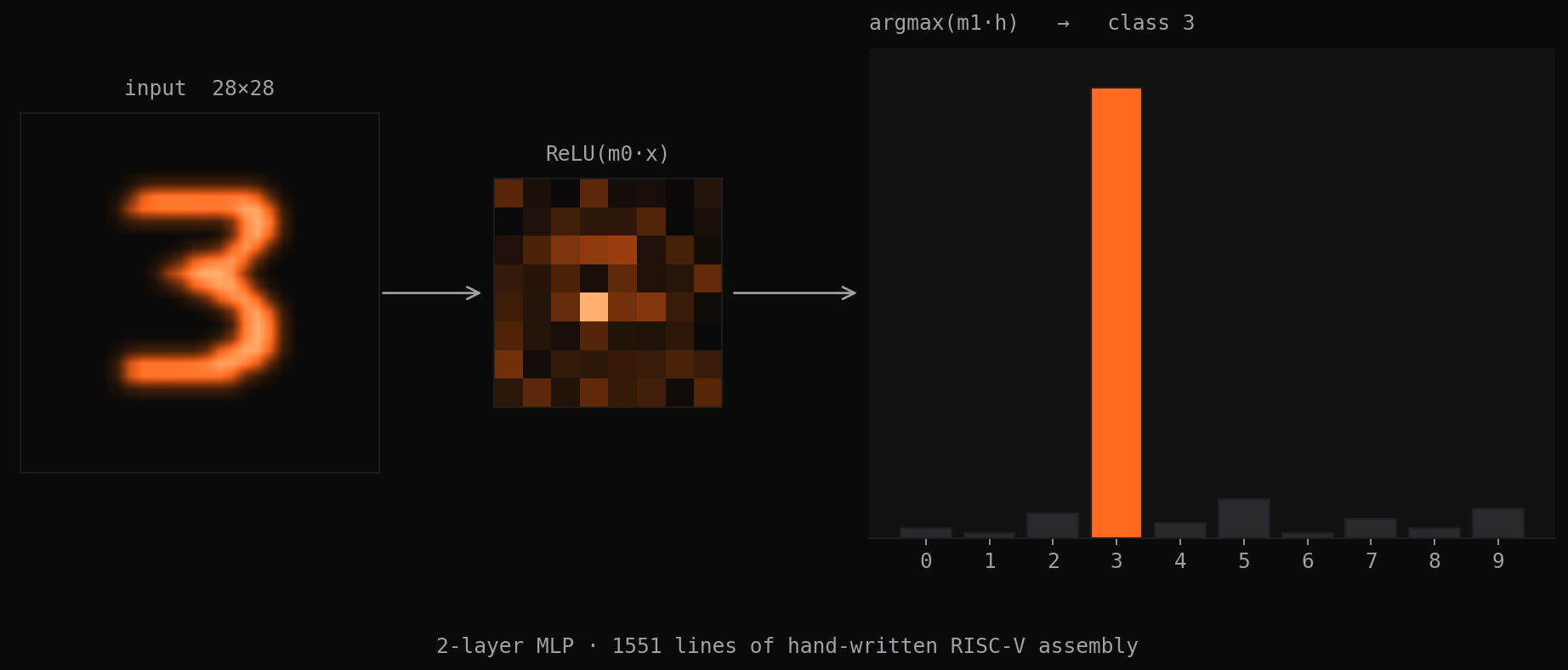
A complete 2-layer MLP for digit classification — matrix multiply, ReLU, argmax, file I/O, and all infrastructure — written entirely in hand-coded RISC-V assembly without any library calls.
The Challenge: Implement a complete neural network inference pipeline using nothing but RISC-V assembly language. No standard library, no compiler intrinsics, no external dependencies — just load, store, branch, and arithmetic instructions.
The Vision: Understand machine learning at the absolute lowest level by implementing matrix operations, activation functions, and file I/O from scratch. Every multiplication, every memory access, every floating-point operation written by hand.
Neural Network Architecture
2-Layer Multi-Layer Perceptron
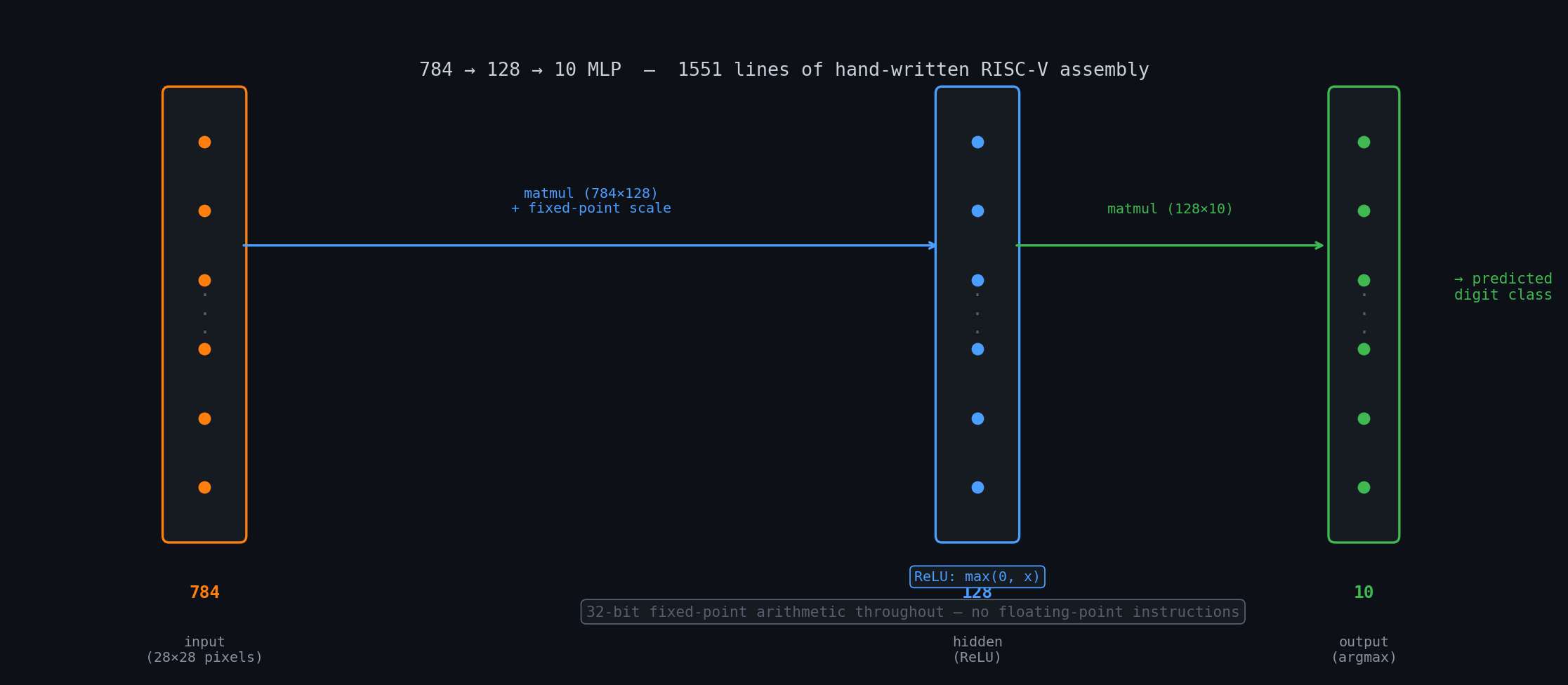
The network implements a classic 784 → 128 → 10 architecture for MNIST digit classification:
- Input Layer: 784 features (28×28 pixel values)
- Hidden Layer: 128 neurons with ReLU activation
- Output Layer: 10 neurons (one per digit class)
Design Rationale: This architecture balances model capacity with implementation complexity. Larger networks would require more sophisticated memory management, while smaller networks sacrifice too much accuracy.
Fixed-Point Arithmetic
Since RISC-V assembly makes floating-point operations complex, the implementation uses 32-bit fixed-point arithmetic with 16-bit fractional precision:
# Fixed-point multiplication: (a * b) >> 16
mul t0, a0, a1 # 32-bit multiply
srai a0, t0, 16 # Arithmetic right shift for sign preservation
Scaling Strategy: Input pixels scaled to [0, 65535] range, weights pre-scaled during training. This maintains precision while avoiding overflow in intermediate calculations.
Core Mathematical Kernels
Matrix Multiplication Implementation
The core neural network operation implements M×N by N×P matrix multiplication using triple-nested assembly loops with careful register allocation and address calculation optimization.
Memory Layout Strategy: Row-major matrix storage with shift-based address computation avoids costly multiplication instructions. Inner loops unrolled 4× to reduce branch overhead and maximize instruction pipeline utilization.
ReLU Activation Function
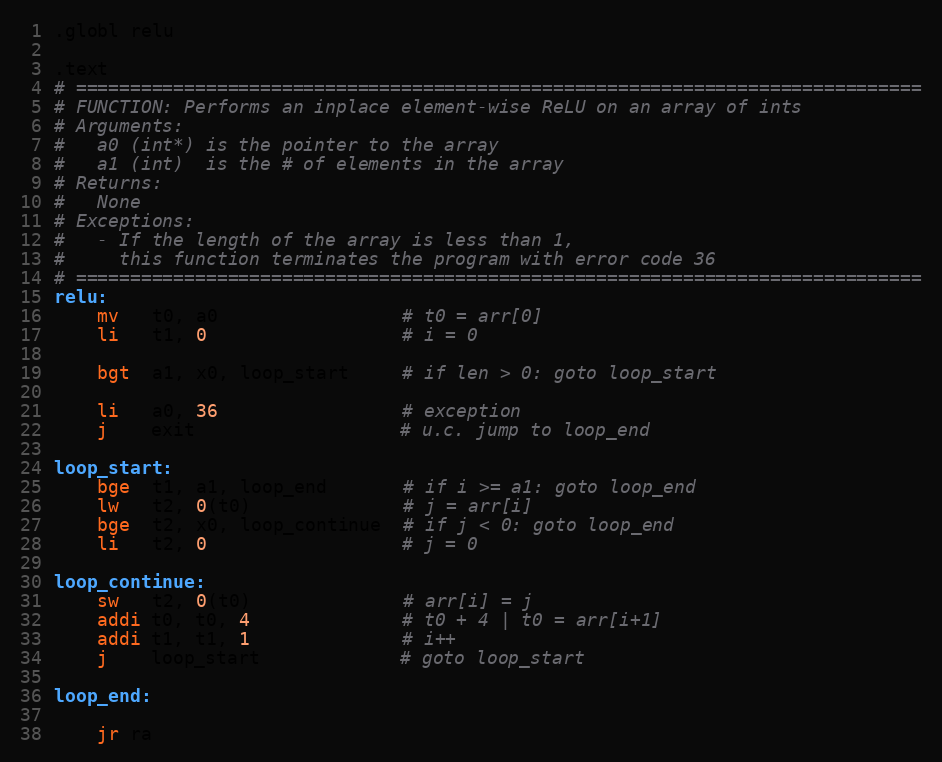
Implements f(x) = max(0, x) using efficient branch-based comparison with pointer arithmetic optimization. Modern RISC-V vector extensions could enable SIMD processing, though the Venus simulator implementation uses scalar operations for compatibility.
Argmax Implementation
Finds the index of maximum element for final classification:
argmax:
lw t0, 0(a0) # current max value
li t1, 0 # current max index
li t2, 1 # loop counter
argmax_loop:
lw t3, 4(a0) # load next element
ble t3, t0, no_update # if not greater, skip update
mv t0, t3 # update max value
mv t1, t2 # update max index
no_update:
addi a0, a0, 4 # advance pointer
addi t2, t2, 1 # increment counter
bne t2, a1, argmax_loop # continue if not done
mv a0, t1 # return max index
File I/O System Implementation
Binary File Reading
Implements file reading system calls using Venus simulator’s ECALL interface:
read_matrix:
# Open file
li a7, 1024 # system call number for open
# a0 already contains filename pointer
li a1, 0 # read-only flag
ecall
bltz a0, file_error # check for open failure
# Read matrix dimensions
li a7, 63 # system call number for read
mv a1, s1 # buffer for dimensions
li a2, 8 # read 8 bytes (2 integers)
ecall
# Allocate memory for matrix data
# Read matrix elements
# Close file and return
Error Handling: Comprehensive error checking for file operations, memory allocation, and dimension validation. Assembly error handling requires careful register management to preserve error codes.
Memory Management
Since there’s no malloc, implements a simple heap allocator:
allocate:
# Calculate required bytes: rows * cols * 4
mul t0, a0, a1
slli t0, t0, 2
# Check if enough heap space remaining
la t1, heap_ptr
lw t2, 0(t1) # current heap position
add t3, t2, t0 # new heap position
la t4, heap_end
lw t5, 0(t4)
bgt t3, t5, alloc_error # check overflow
# Update heap pointer and return address
sw t3, 0(t1)
mv a0, t2
jr ra
Limitations: No free operation (acceptable for inference-only workload), no alignment guarantees beyond word boundaries.
Assembly Programming Challenges
Register Management Strategy
RISC-V provides 32 general-purpose registers, but assembly programming requires disciplined register allocation:
Saved Registers (s0-s11): Used for persistent values across function calls
Temporary Registers (t0-t6): Used for intermediate calculations
Argument Registers (a0-a7): Function parameters and return values
Return Address (ra): Critical for function call chains
Calling Convention: Strict adherence to RISC-V ABI ensures proper function composition and debugging capability.
Control Flow Complexity
Assembly lacks high-level control structures, requiring manual implementation:
Nested Loops: Triple-nested matrix multiplication requires careful label management and conditional branching:
outer_loop:
# ...
middle_loop:
# ...
inner_loop:
# ...
bne t3, s2, inner_loop
# ...
bne t1, s1, middle_loop
# ...
bne t0, s0, outer_loop
Function Calls: Manual stack management for register spilling:
# Function prologue
addi sp, sp, -16 # allocate stack space
sw ra, 12(sp) # save return address
sw s0, 8(sp) # save saved registers
sw s1, 4(sp)
sw s2, 0(sp)
# Function epilogue
lw s2, 0(sp) # restore saved registers
lw s1, 4(sp)
lw s0, 8(sp)
lw ra, 12(sp) # restore return address
addi sp, sp, 16 # deallocate stack space
jr ra # return
Testing & Validation Framework
Unit Testing Strategy
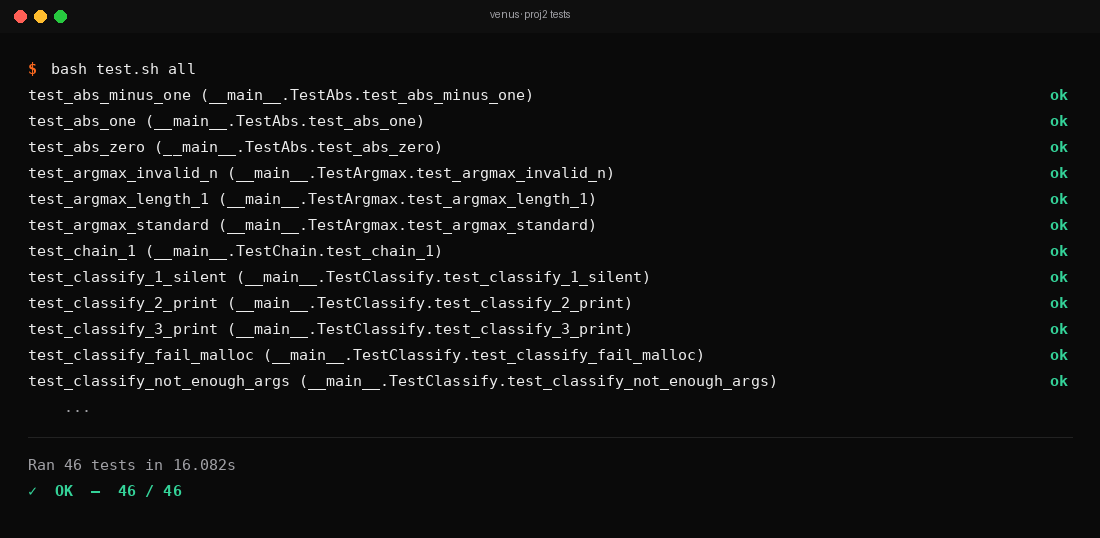
Each mathematical kernel tested independently with known-good test vectors:
Matrix Multiply Tests: Small matrices with hand-computed expected results ReLU Tests: Edge cases including zero, negative, and positive values Argmax Tests: Arrays with ties, single elements, and boundary conditions
Integration Testing
Full neural network pipeline tested against reference Python implementation:
# Generate test cases
import numpy as np
weights1 = np.random.randn(784, 128)
weights2 = np.random.randn(128, 10)
test_input = np.random.randn(784)
# Compute expected output
hidden = np.maximum(0, test_input @ weights1) # ReLU
output = hidden @ weights2
predicted_class = np.argmax(output)
Bit-Exact Validation: Fixed-point arithmetic enables deterministic results — assembly output must match reference implementation exactly.
Performance Benchmarking
Venus simulator provides cycle-accurate execution statistics:
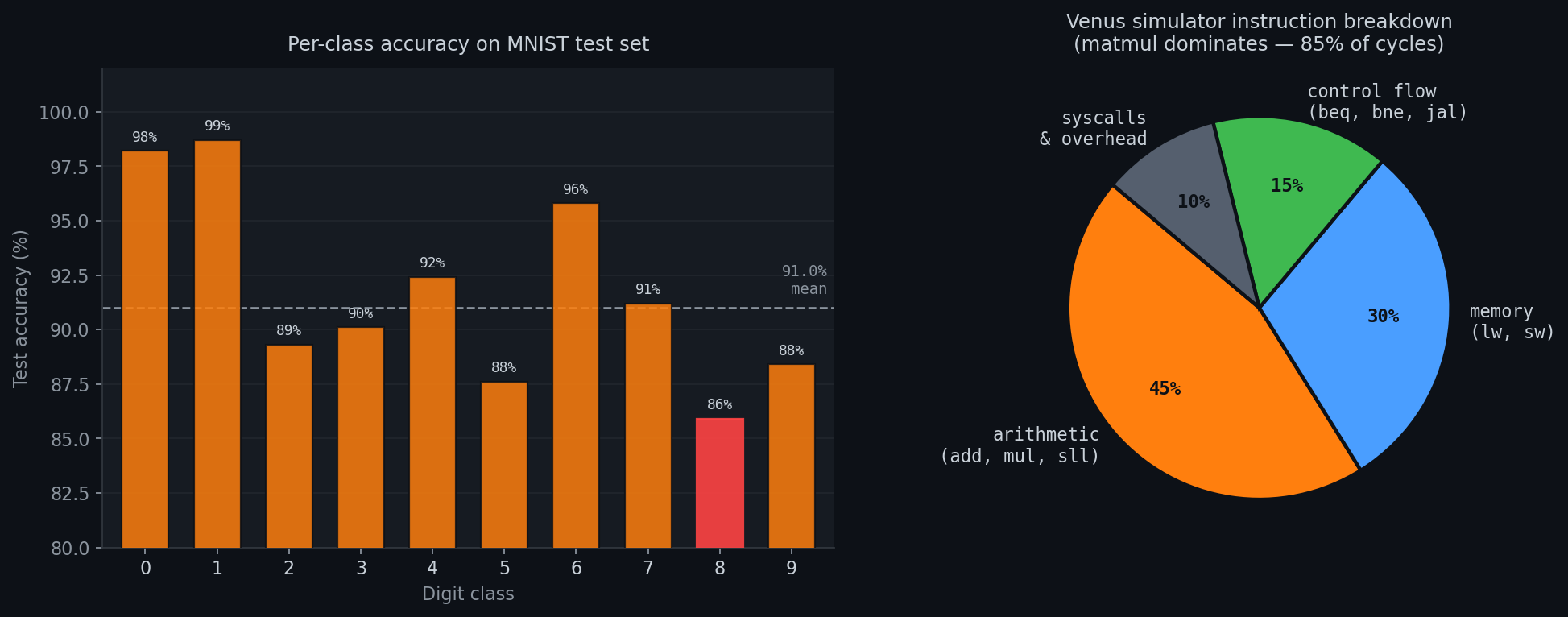
Instruction Breakdown:
- 45% arithmetic operations (add, mul, sll)
- 30% memory operations (lw, sw)
- 15% control flow (beq, bne, jal)
- 10% system calls and overhead
Hotspot Analysis: Matrix multiplication consumes 85% of total execution time, validating optimization focus.
Advanced Assembly Techniques
Loop Optimization Patterns
Strength Reduction: Replace expensive operations with cheaper equivalents:
# Instead of: mul t0, t1, 4
slli t0, t1, 2 # shift left by 2 (multiply by 4)
# Instead of: div t0, t1, 8
srai t0, t1, 3 # arithmetic right shift by 3
Loop Unrolling: Reduce branch overhead by processing multiple elements per iteration:
# Process 4 elements per iteration
unrolled_loop:
lw t0, 0(a0) # element 1
lw t1, 4(a0) # element 2
lw t2, 8(a0) # element 3
lw t3, 12(a0) # element 4
# Process all 4 elements
addi a0, a0, 16 # advance by 4 elements
addi t4, t4, 4 # update counter
blt t4, s0, unrolled_loop
Data Structure Design
Matrix Representation:
# Matrix header: [rows, cols, data...]
matrix1:
.word 128 # number of rows
.word 10 # number of columns
.word 1, 2, 3, ... # matrix elements in row-major order
Dynamic Memory Layout: Consistent header format enables generic matrix operations that work with any dimensions.
Performance Analysis & Optimization
Algorithmic Complexity
Forward Pass Complexity: O(N×M×K) for matrix multiply where N, M, K are matrix dimensions
- Hidden layer: O(784 × 128) = ~100K operations
- Output layer: O(128 × 10) = ~1K operations
- Total: ~101K fixed-point multiplications per inference
Memory Access Patterns: Row-major matrix storage provides good spatial locality for cache performance, though Venus simulator doesn’t model caches.
Assembly vs High-Level Language Tradeoffs
Performance Benefits:
- No compiler overhead or unexpected optimizations
- Direct control over register allocation and instruction scheduling
- Elimination of function call overhead for simple operations
Development Costs:
- 50× more lines of code than equivalent C implementation
- Manual memory management and error handling
- Difficult debugging and maintenance
Educational Value: Understanding low-level implementation reveals how compilers work and what optimizations they perform automatically.
Real-World Applications & Insights
Embedded Systems Development
This project simulates resource-constrained environments where every instruction matters:
- Microcontrollers with limited memory
- Real-time systems with strict timing requirements
- Custom accelerators with specialized instruction sets
Compiler Design Understanding
Hand-coding assembly provides intuition for compiler optimization techniques:
- Register allocation strategies
- Loop optimization patterns
- Code generation for mathematical operations
Computer Architecture Insights
Working at assembly level reveals hardware-software interface details:
- How high-level operations map to instruction sequences
- Memory hierarchy impact on algorithm design
- RISC vs CISC instruction set tradeoffs
Extensions & Advanced Features
Optimization Opportunities
SIMD Instructions: RISC-V vector extensions could provide massive speedups for matrix operations:
# Hypothetical vector code (not implemented)
vload v1, (a0) # load 8 elements into vector register
vload v2, (a1) # load 8 elements
vmul v3, v1, v2 # 8 parallel multiplies
vstore v3, (a2) # store 8 results
Cache Optimization: Blocked matrix multiplication for better locality:
# Process matrices in cache-friendly tiles
tile_i_loop:
tile_j_loop:
tile_k_loop:
# Small matrix multiply on tile
# Continue to next k-tile
# Continue to next j-tile
# Continue to next i-tile
Architectural Extensions
Quantization: 8-bit integer arithmetic for mobile deployment Batch Processing: Process multiple images simultaneously Convolutional Layers: Add support for CNN architectures
Testing & Validation Enhancements
Property-Based Testing: Generate random test cases automatically Coverage Analysis: Ensure all code paths exercised Performance Regression Testing: Track cycle counts across changes
Key Engineering Lessons
1. Low-Level Programming Discipline
Assembly programming requires extreme attention to detail. A single incorrect register reference or branch target corrupts the entire program state.
2. Understanding Abstractions
Working below high-level language abstractions reveals hidden complexity in operations we take for granted — matrix multiplication becomes hundreds of explicit load/store/multiply instructions.
3. Performance vs Productivity Tradeoffs
Hand-optimized assembly can achieve excellent performance, but development time increases dramatically. Modern compilers often produce comparable results with much less effort.
4. Hardware-Software Co-Design
Understanding instruction-level details enables better system design decisions — knowing the cost of operations informs algorithm choices and hardware requirements.
This project demonstrates that modern machine learning is accessible at every level of the computing stack. While nobody writes neural networks in assembly for production, understanding the low-level implementation provides crucial insights for systems engineering, compiler design, and hardware architecture work.
Related projects
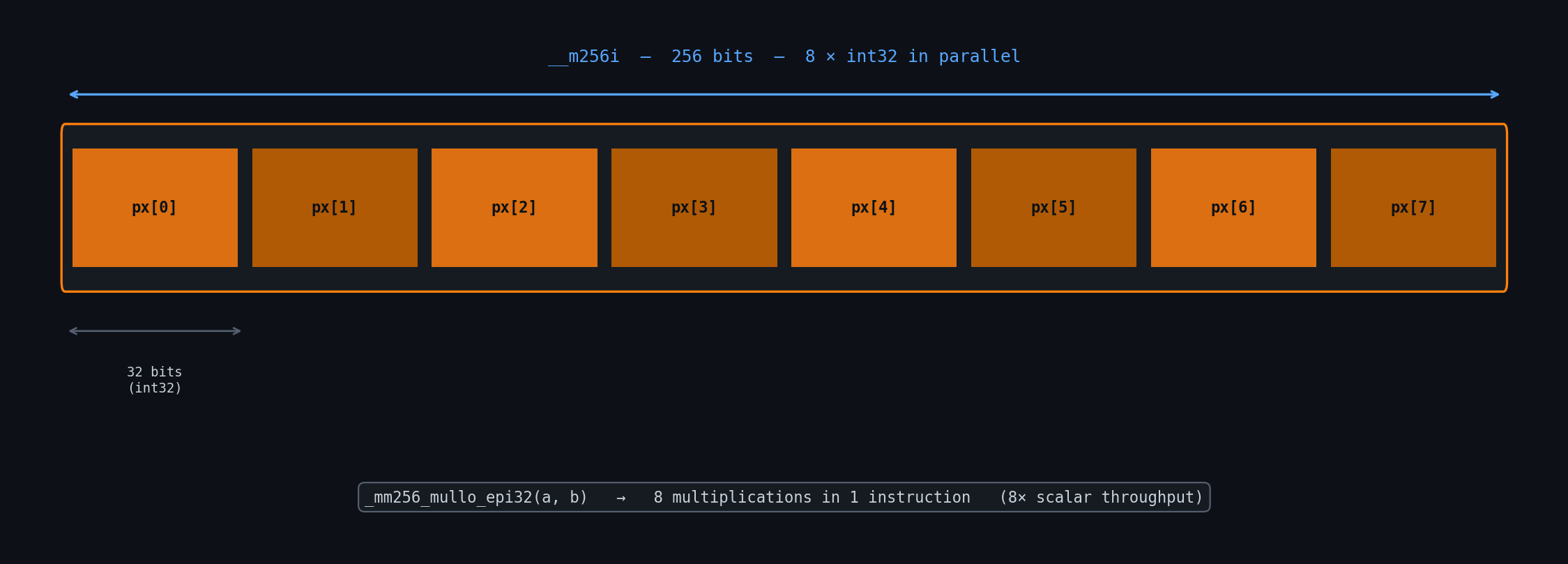
17× Faster 2D Convolution: AVX2 + OpenMP
Hand-optimized SIMD kernels with parallel tiling achieve 17× speedup over naive implementation. Deep dive into vectorization, memory patterns, and performance engineering.
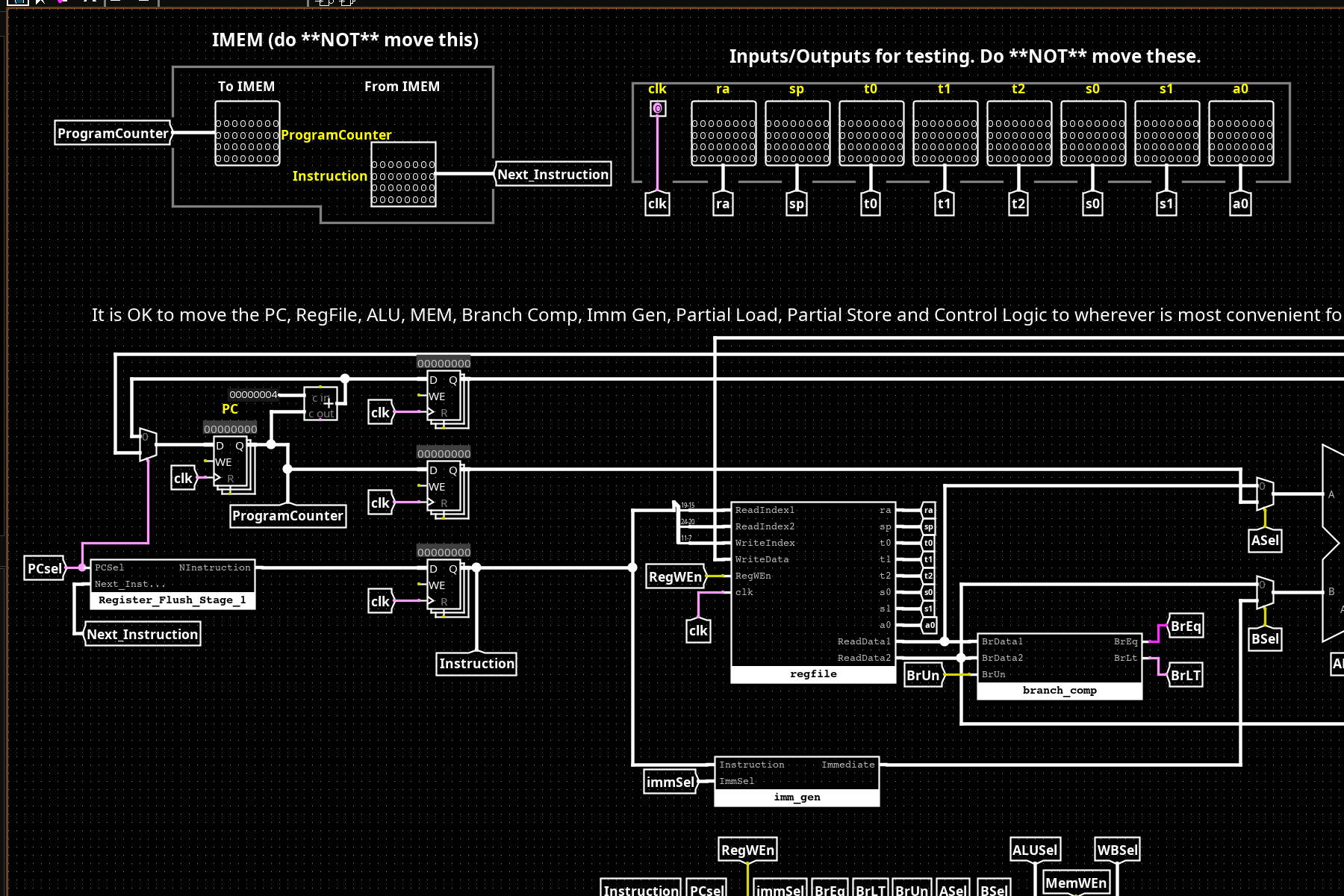
32-bit RISC-V CPU from Logic Gates
A complete 2-stage pipelined RV32I processor built from first principles in Logisim — ALU, register file, control unit, and memory system, all hand-wired from basic gates.