Does a Merge Planner Need a Model of the Traffic?
Three planners share one control interface and differ only in what they believe about the car behind them: nothing, everything, or whatever they can learn. Across 41,130 episodes on 914 held-out Waymo scenes, a correct model of the follower is worth everything in one narrow band of gap sizes and nothing outside it, and the moment it is wrong, the planner that trusted it drops to zero. A learned policy wins the opposite regime, but a control proves it wins by acting early rather than by understanding anything.
A car merging into dense traffic needs a gap that may not exist yet but might open, if the driver behind decides to let it. How much is it worth to know how traffic will react to you?
Three planners, one (lateral, speed) setpoint interface, one tracker. Only the decision layer differs, so every difference in outcome is attributable to it.
| believes about the follower | |
|---|---|
| Arm 1 | nothing: predicts constant velocity |
| Arm 2 | everything: its rollout imports its constants from the module that drives the follower |
| Arm 3 | whatever PPO learns from interaction |
What “refusing to merge” actually looks like
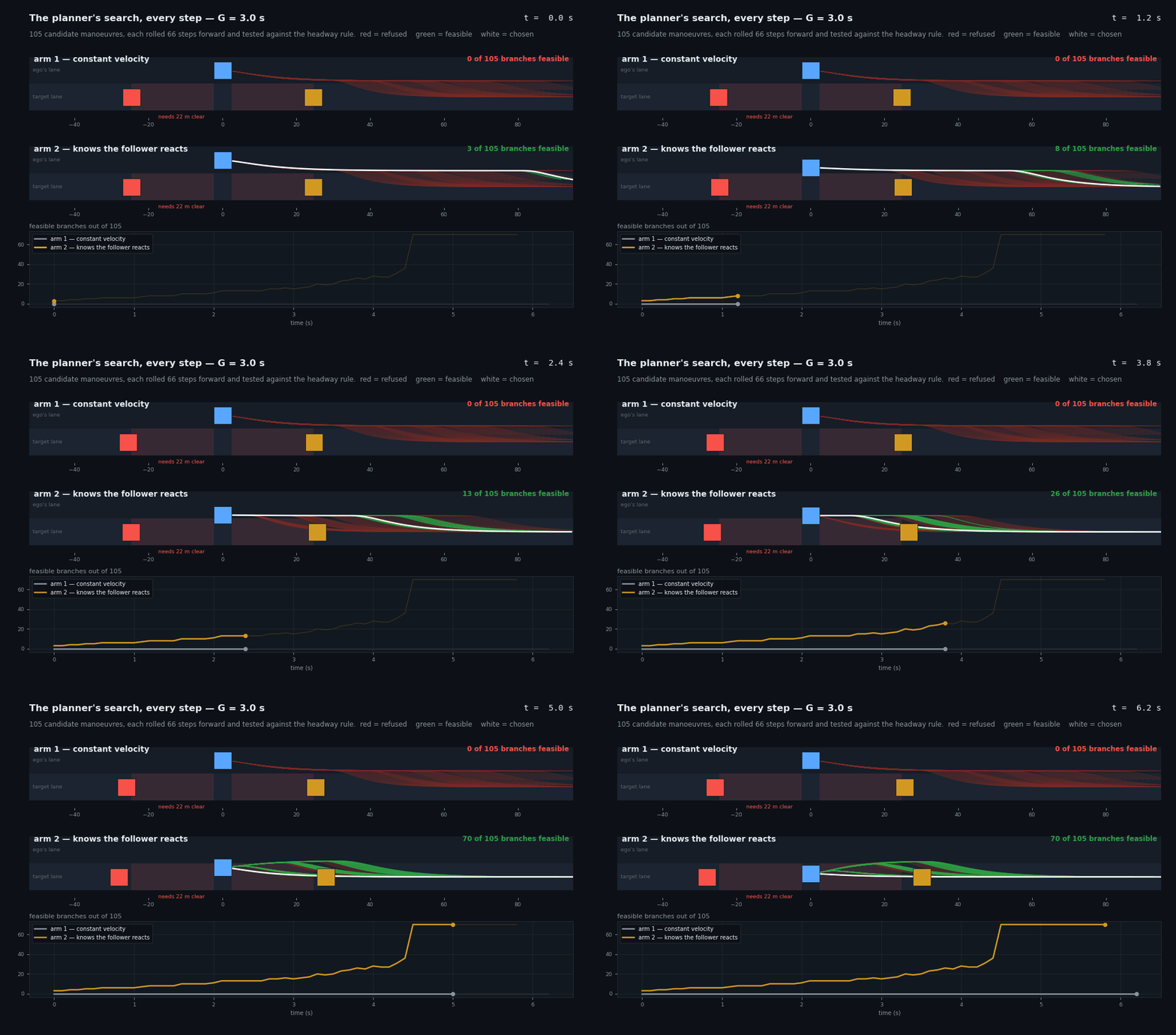
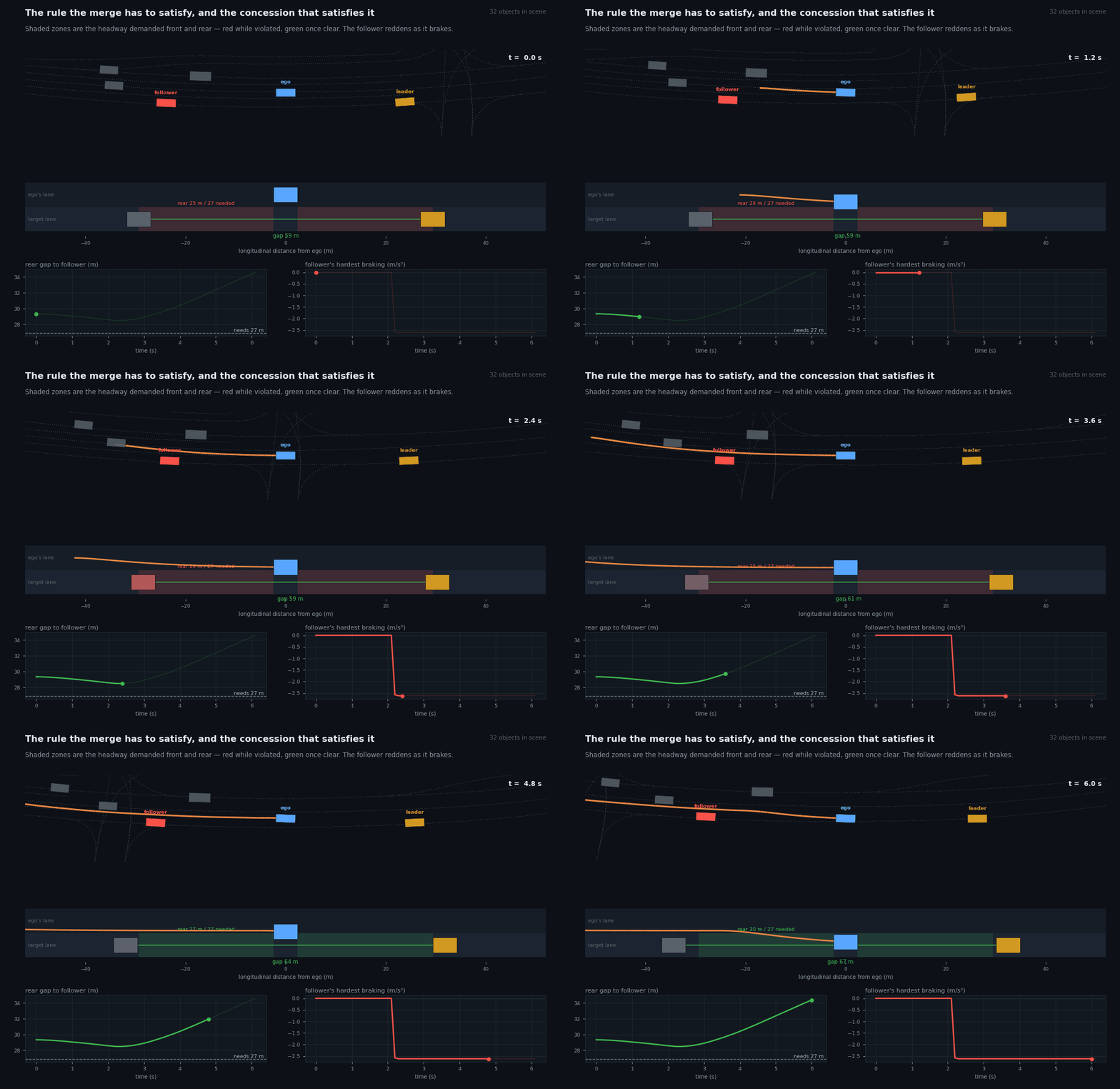
Arm 1 is not idle. It searches exhaustively and finds nothing, 105 times a step, for the whole episode.
The result
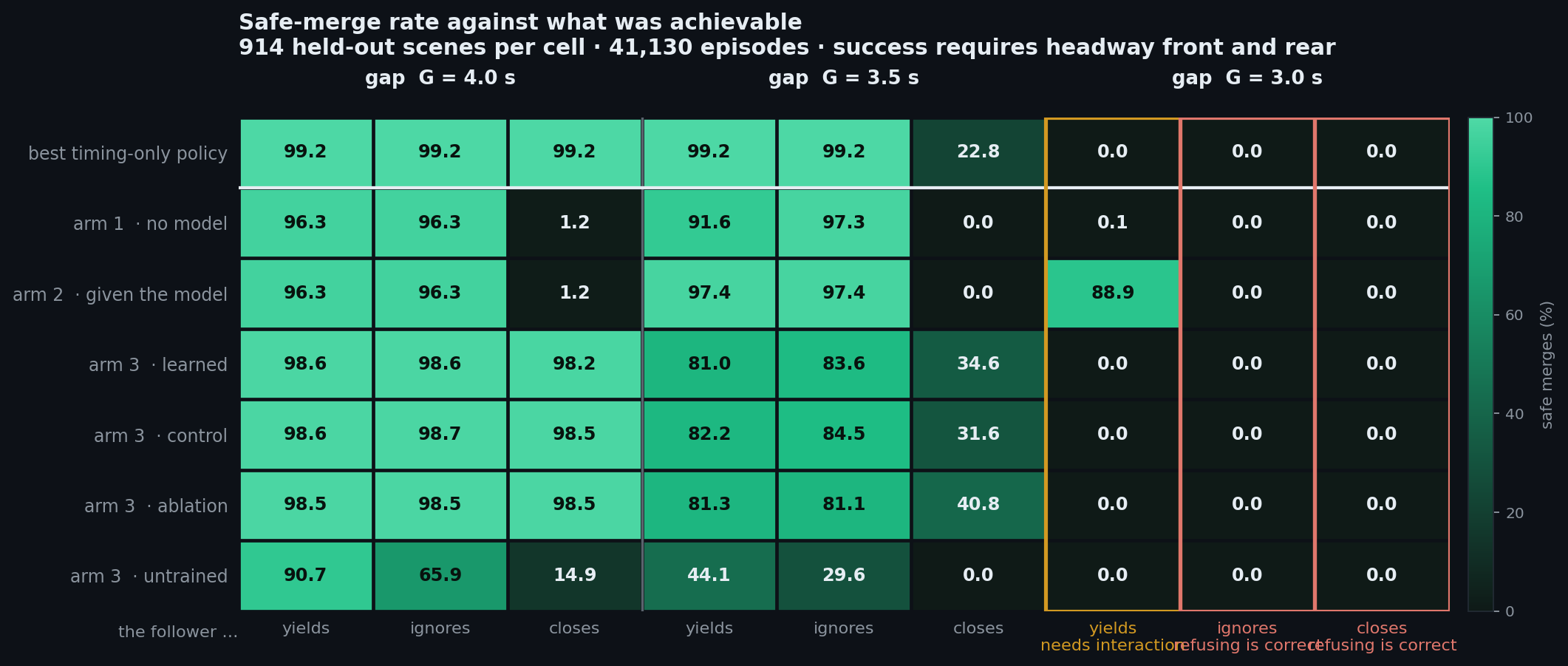
The top row is the ceiling, and it changes how every other row reads. It is the best a policy can do that only decides when to commit, found by sweeping every commit time across the episode and asking whether any of them yields a legal merge.
Three cells where 0.0% is the correct answer, not a failure. An ego centred in a slot of G seconds holds G/2 seconds of headway each side and needs 1.5, so at G = 3.0 the slack is algebraically zero. Against a follower that cannot be induced to concede, no policy should merge there, and none does.
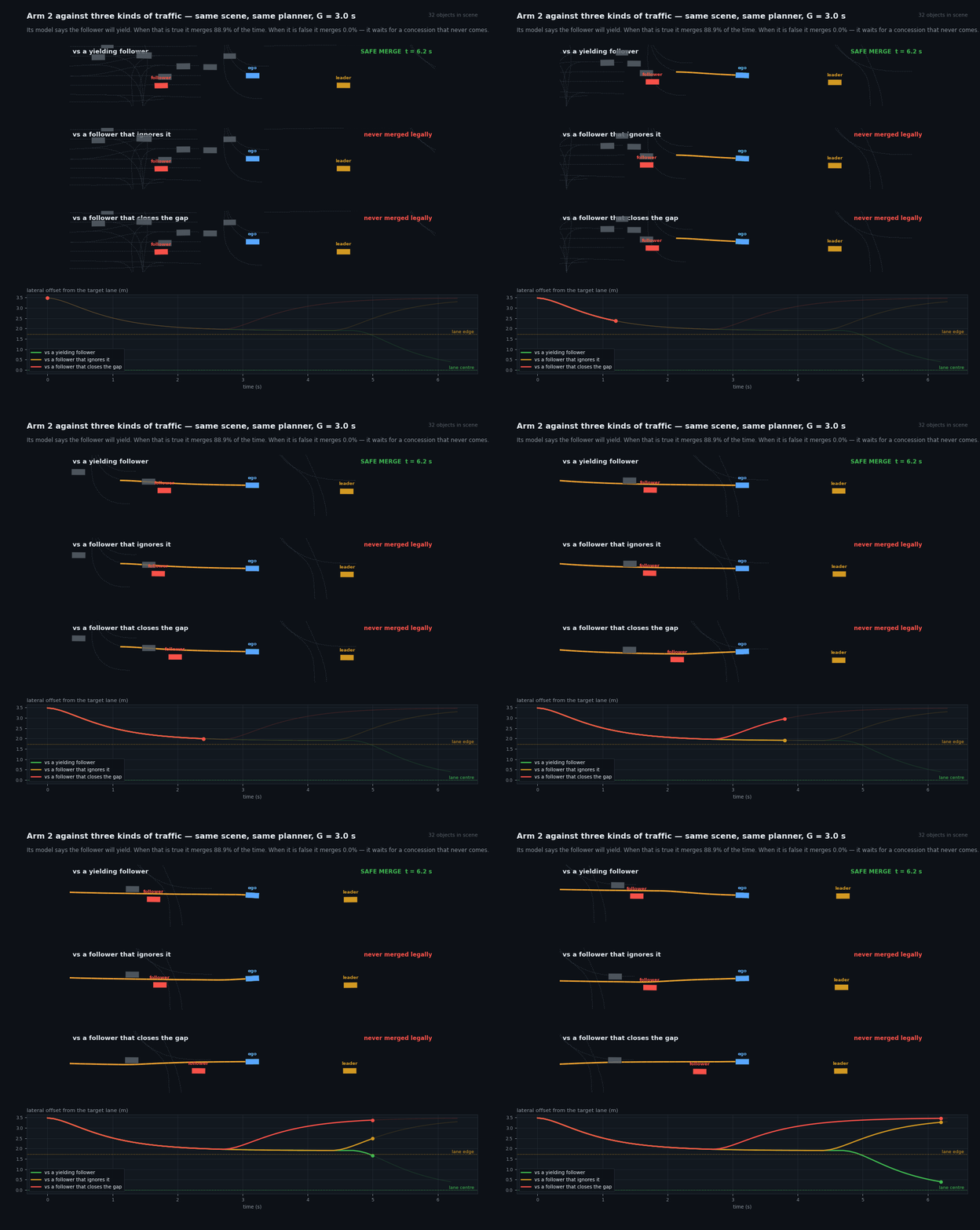
One cell where 88.9% beats a ceiling of zero. At G = 3.0 against a yielding follower, timing alone achieves nothing, because the oracle never encroaches and so the follower never lifts off. Arm 2 scores 88.9% by creating the gap rather than waiting for one. That is the cleanest evidence in the project that its handed-over model buys genuine interaction rather than better timing.
And the planners’ 1.2% against a closer is now unambiguously a miss. The ceiling there is 99.2%: a safe merge existed in essentially every scene, available from step 0, and both planners failed to take it.
Where the learned policy genuinely wins
Paired McNemar on identical scenes, arm 3 against the better planner in each cell:
| cell | arm 3 | best planner | planner-only wins | arm3-only wins | p |
|---|---|---|---|---|---|
| G = 4.0, closes | 98.2% | 1.2% | 0 | 887 | 1.9 × 10⁻²⁶⁷ |
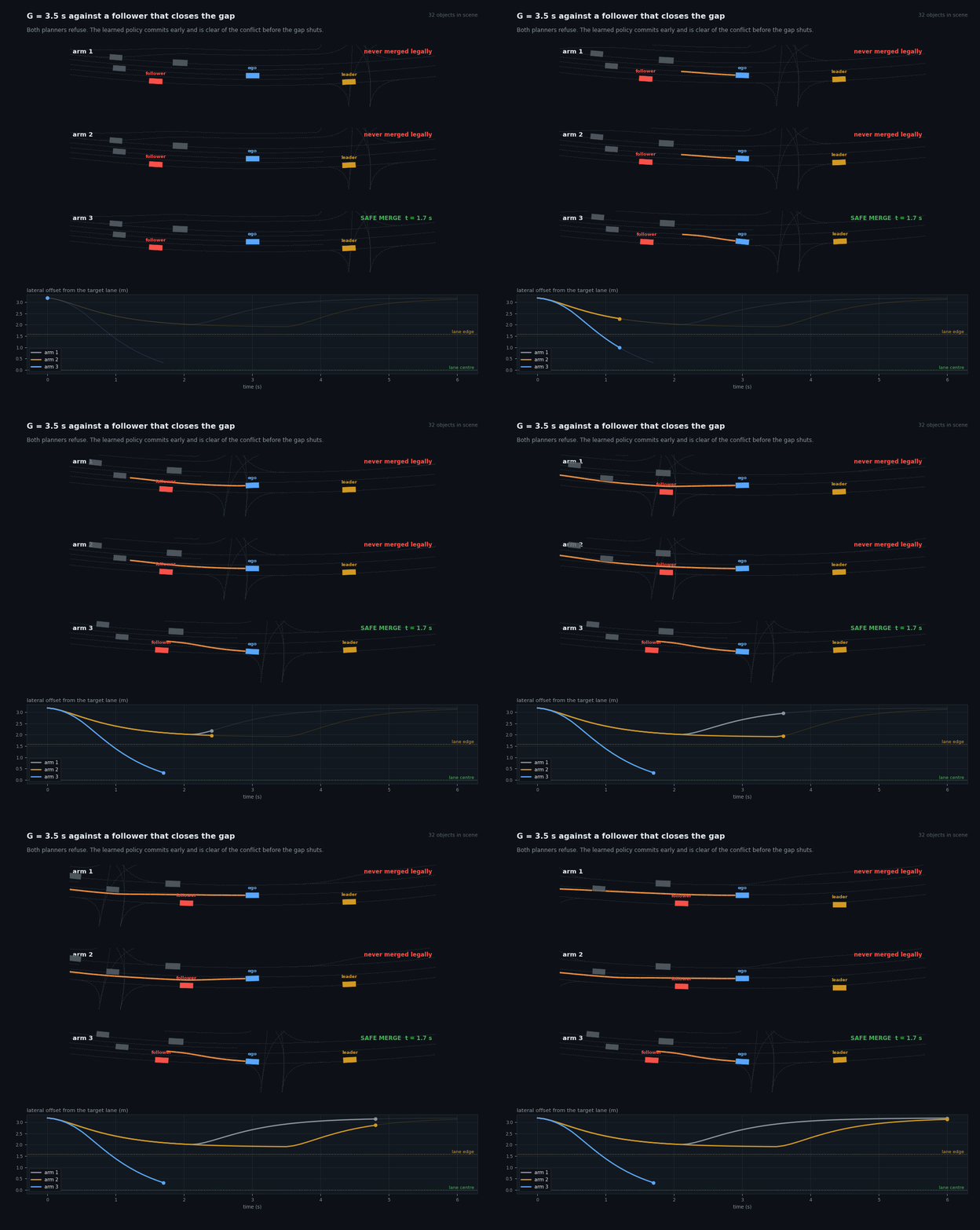
| G = 3.5, closes | 34.6% | 0.0% | 0 | 316 | 1.5 × 10⁻⁹⁵ |
| G = 4.0, yields | 98.6% | 96.3% | 0 | 21 | 9.5 × 10⁻⁷ |
| G = 4.0, ignores | 98.6% | 96.3% | 0 | 21 | 9.5 × 10⁻⁷ |
| G = 3.5, yields | 81.0% | 97.4% | 166 | 16 | 1.3 × 10⁻³² |
| G = 3.0, yields | 0.0% | 88.9% | 813 | 0 | 3.7 × 10⁻²⁴⁵ |
In the four cells it wins, it never loses a scenario the planner wins. That is strict dominance, not a better average. The most interesting is G = 4.0 against a yielding follower: the traffic arm 2’s model describes exactly, where a policy with no model still wins 21 scenes and loses none.
What the learning actually bought
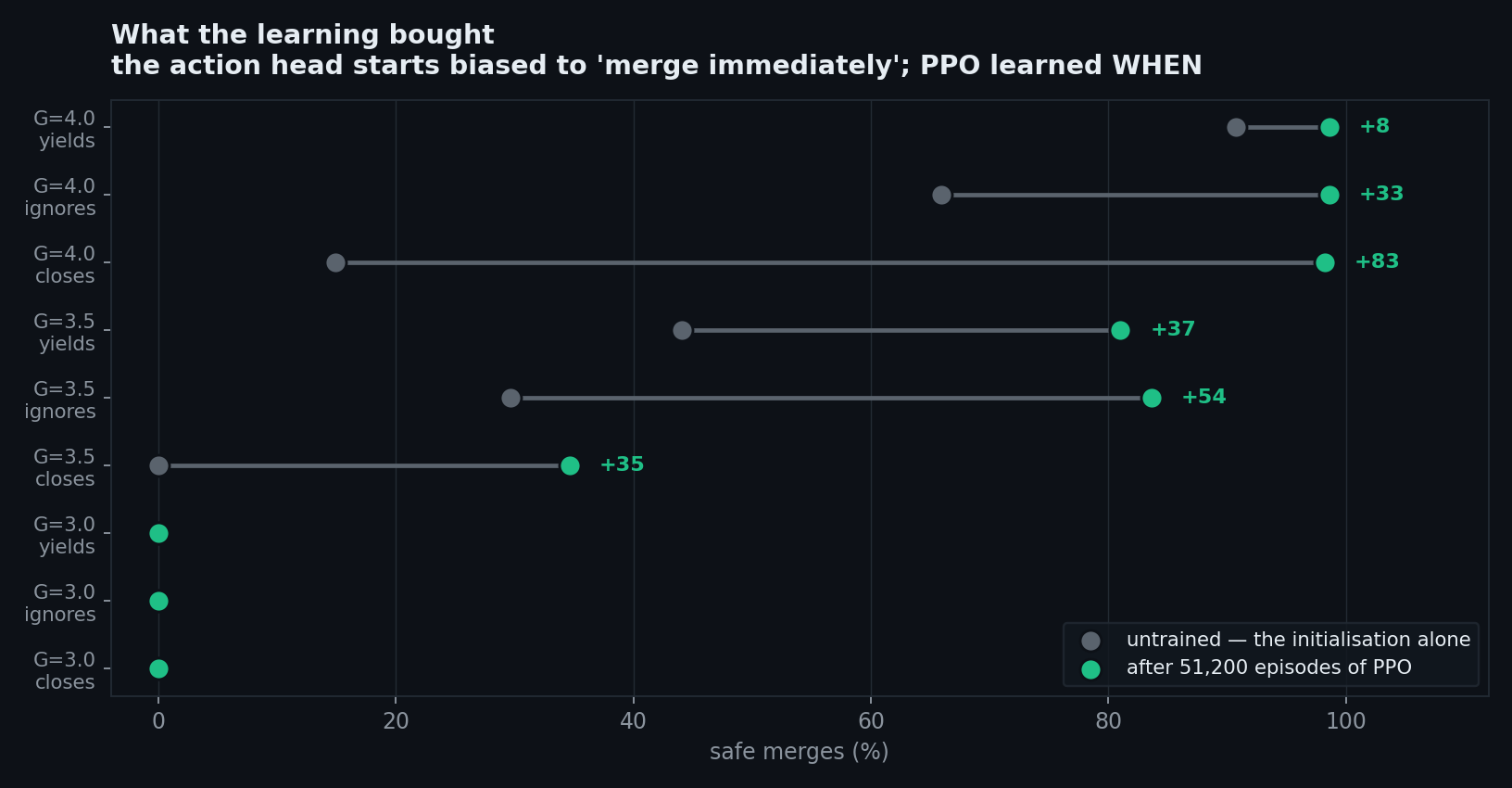
The untrained network settles in-lane 98–99.5% of the time in every cell. It merges just as often as the trained one; it merges illegally. PPO is worth +83 points at G = 4.0 against a closer, and what it learned is when to commit, not who it is facing.
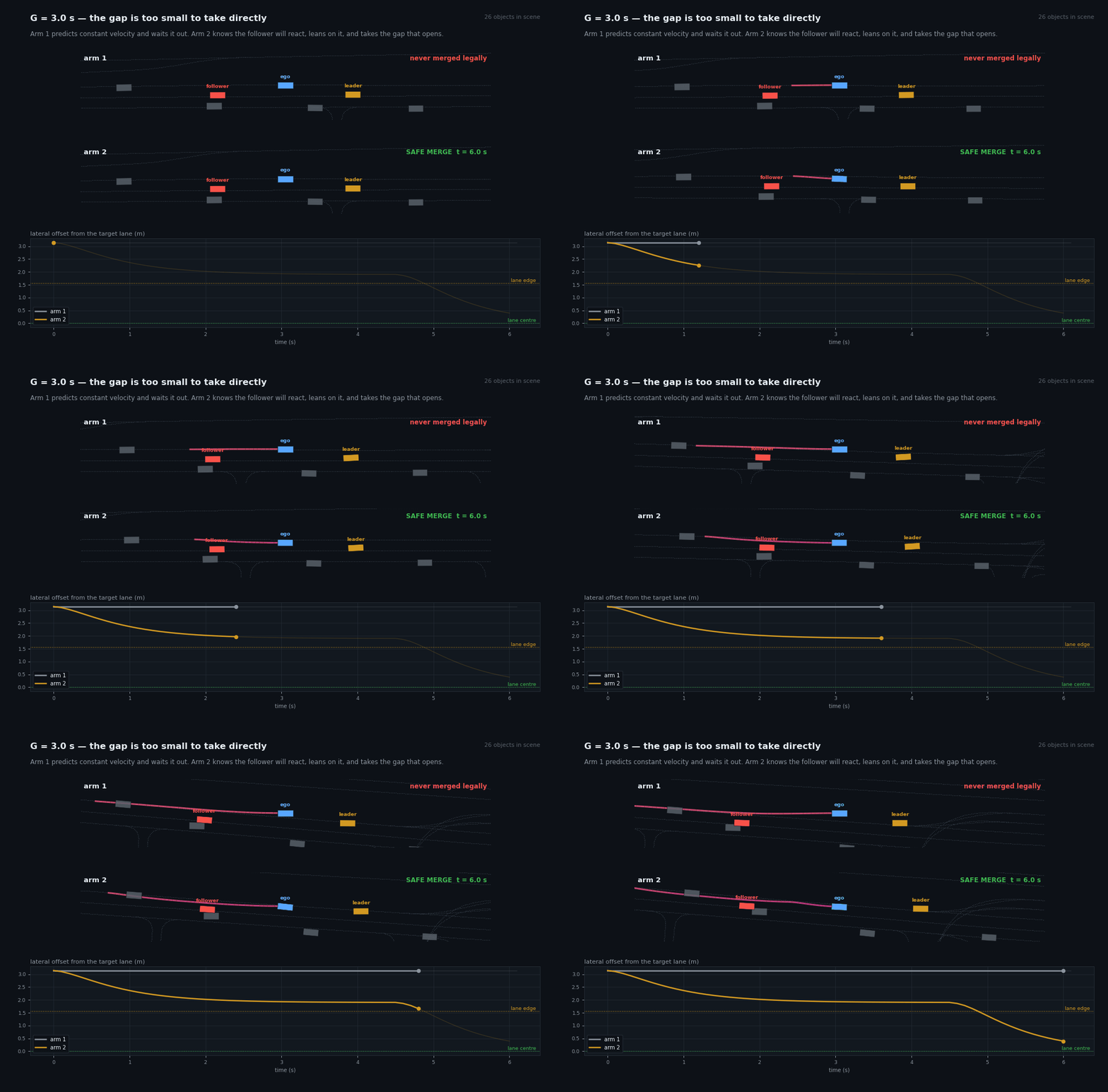
Each arm, doing its thing
The learned policy is not adaptive
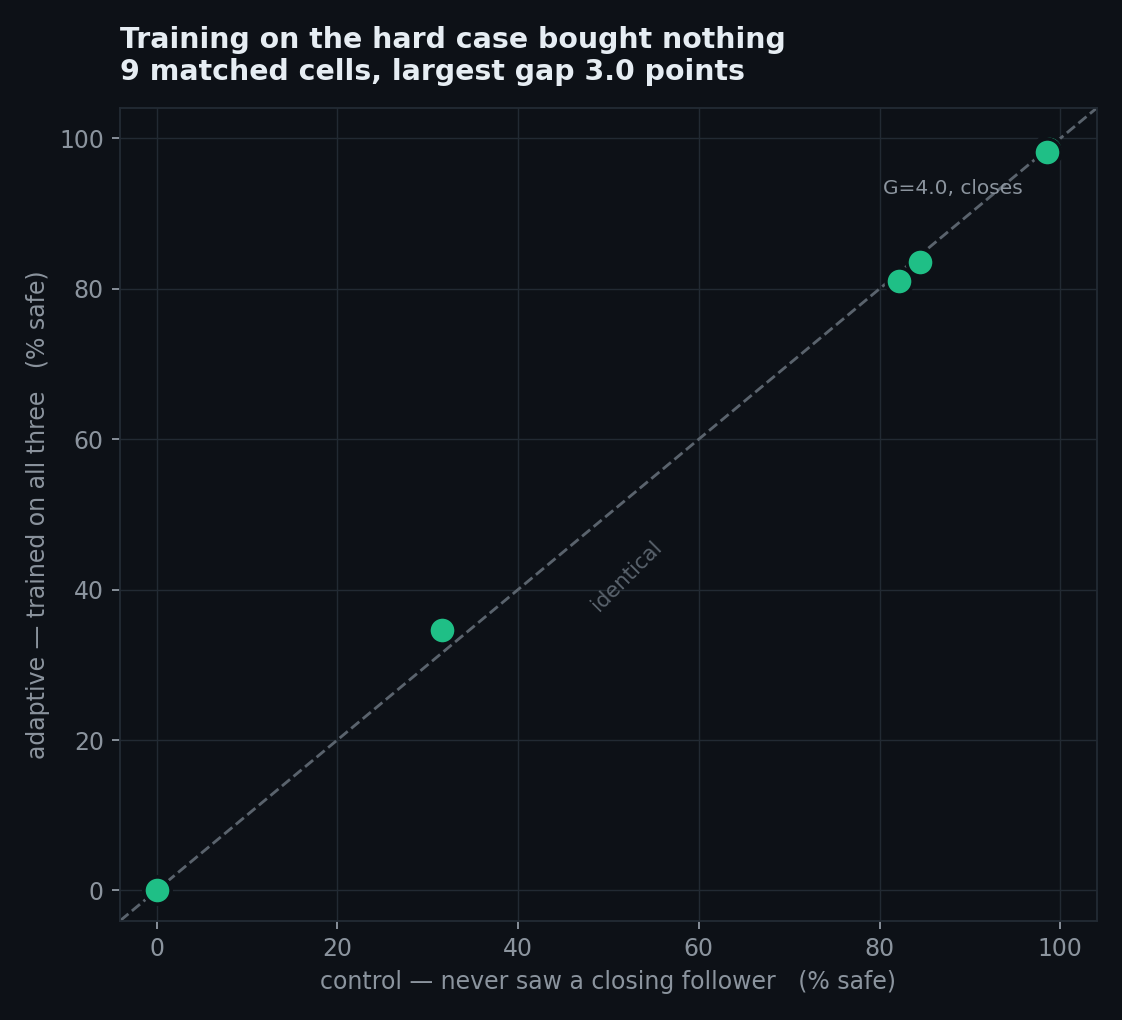
A policy that never encountered a closing follower handles one just as well: 98.5% vs 98.2%, largest gap across nine matched cells 3.0 points.
So two things are true at once: training matters enormously (14.9% → 98.2% over the untrained initialisation) and training on the hard case matters not at all. What PPO learned is a general commit-timing skill, acquired from cooperative traffic and transferred intact to traffic it never saw. It is not adaptivity: the ego never infers who it faces.
Earliness is not free. At G = 3.5 against a yielder arm 3 scores 81.0% against arm 2’s 97.4%, settling in-lane 99.7% of the time. It merges almost always, and about a fifth of those merges are illegal. At G = 3.0 it is a flat 0.0%: it cannot negotiate at all.
That failure is arithmetic, not incentive. The nudge is ~40 consecutive steps holding at the lane edge; the converged policy’s mean sits 2.9σ from that hold, and PPO’s exploration noise is drawn independently per step. Independent noise finds reflexes, never sustained commitments.
What I got wrong
Every arm-3 number this project produced before the audit was invalid. None of the bugs announced themselves.
| defect | consequence | |
|---|---|---|
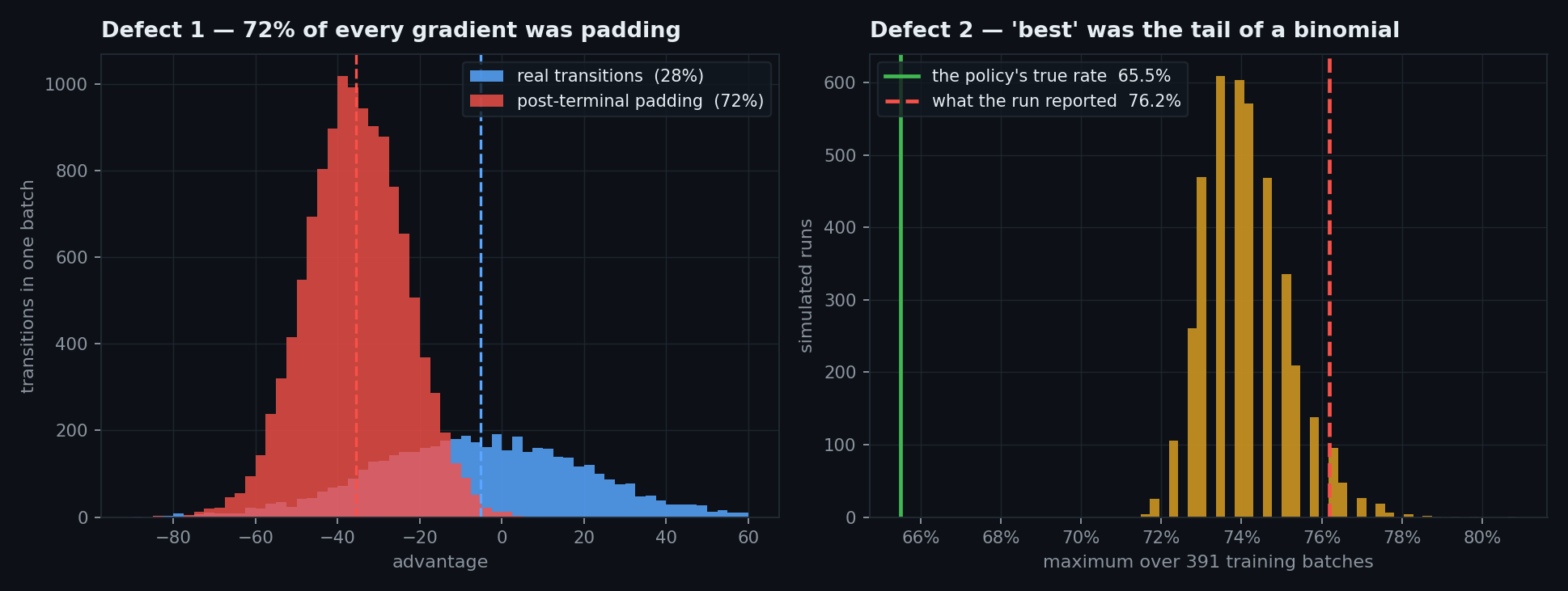
| 1 | 72% of every PPO gradient was post-terminal padding | the advantage normaliser was set by frozen states; ¾ of the gradient pushed down actions taken after the episode ended, concentrated on the episodes that merged earliest |
| 2 | ”best checkpoint” compared a single training batch | for a policy whose true rate is 65.5%, the max over 391 batches averages 74.1%. The run reported 76.2%; the whole signal was sampling noise |
| 3 | the database stored the loose criterion | a policy scores 98.5% on “ended up in the lane” while holding 0.37 s of time-to-collision, against the planner’s 34.5 s |
| 4 | 68 scenes could not measure the effect | ”collision rate doubles” was 3 episodes against 6, Fisher p = 0.49 |
| 5 | the collision metric counted the wrong cars | none of arm 1’s collisions involved the leader or follower; two happened at step 0, inside a parked car |
Defect 5 turned out to be worse than a metric bug. Forcing an immediate merge into the tightest slot in the study:
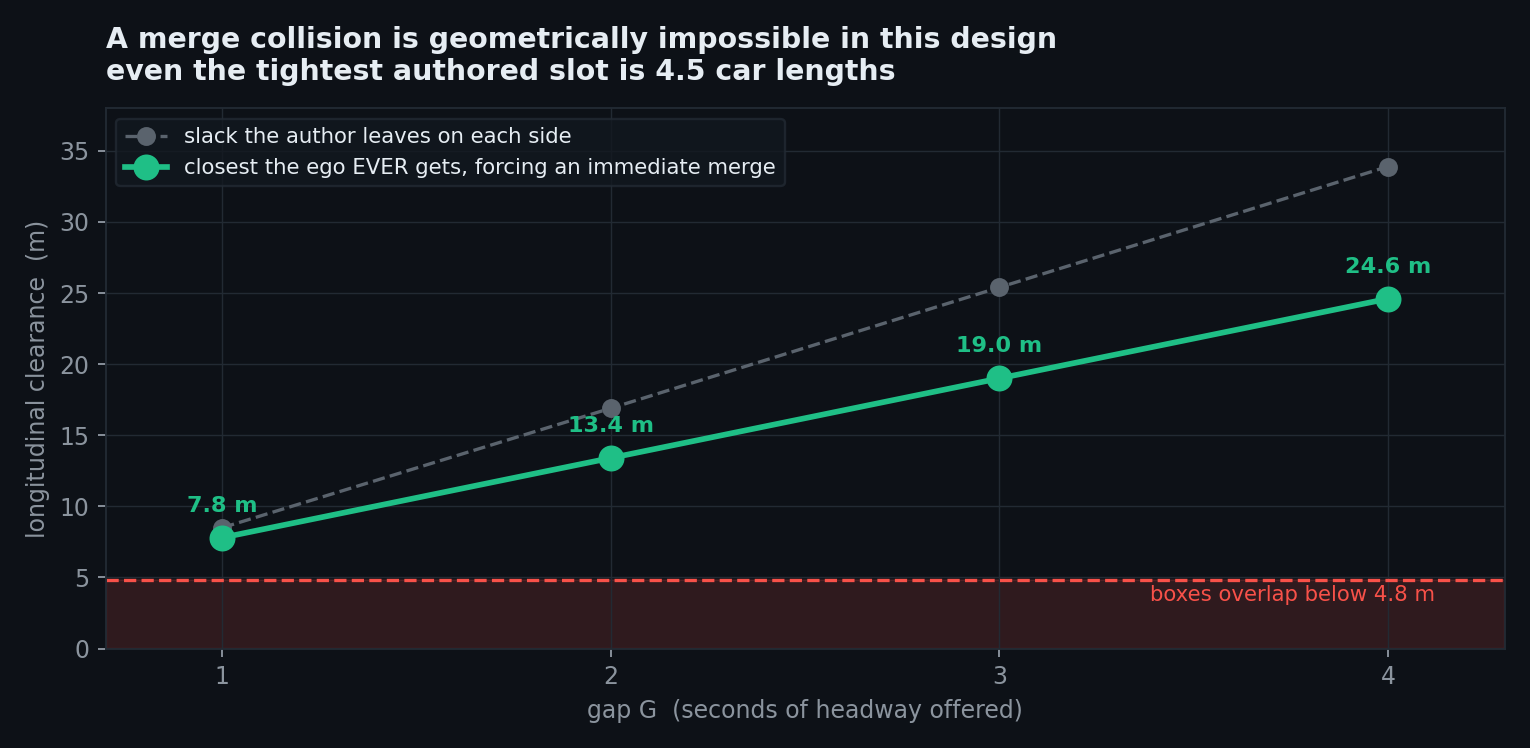
Every collision-based claim is therefore retracted. Any future safety result here needs a redesigned scenario author, or must rest on headway margin alone.
And fixing defect 1 bought nothing. The un-fixed ablation scores within noise everywhere and is significantly better at one cell (40.8% vs 34.6% at G = 3.5 against a closer). A real correctness bug with no measurable performance cost.
Corpus and machinery
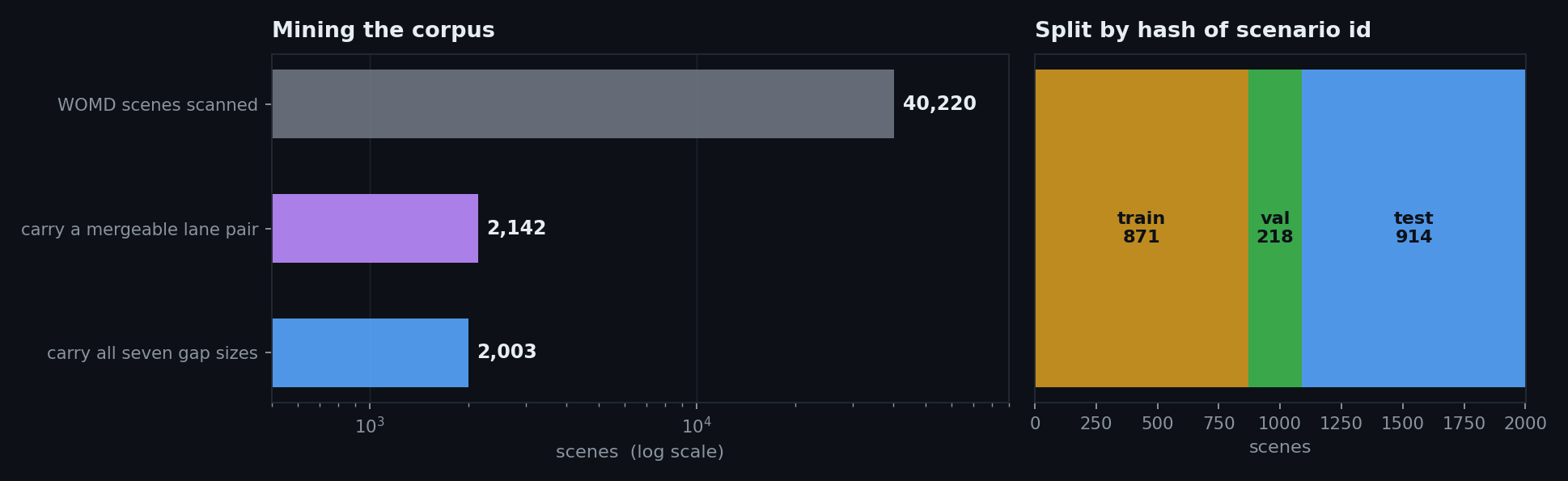
A scene qualifies only if every gap size can be authored on it and the ego has road left to drive the full episode, which keeps the comparison paired across the gap axis instead of mixing scene difficulty into it. The split is a pure function of the scenario id hashed with hashlib, not Python’s builtin hash: the builtin is salted per process and would have put a scene in train inside the trainer and test inside the evaluator, with nothing to report an error.
Throughput came from one observation: the environment’s cost is kernel-launch overhead on 32-element arrays, not arithmetic, so batching divides the fixed cost by B: 21.7× at B = 128. The blocker was the IDM policy’s desired speed being a Python constant baked in at trace time, capping a batch at the largest same-speed group (measured: 8). Carrying it as a traced array lets one compilation serve the whole corpus, with no change to the IDM implementation, which matters, because that class is the oracle everything else is validated against.
Conclusion
Modelling the interaction buys one narrow band of gap sizes; acting fast buys the rest; neither buys both.
Arm 2’s handed-over model is decisive in exactly one cell: G = 3.0 against a yielding follower, where the best timing-only policy scores 0.0% and arm 2 scores 88.9% by inducing the gap. Everywhere else it is worth nothing, and against a follower it has mispredicted it is worth less than nothing.
Arm 3 inverts that profile without ever representing the interaction. It strictly dominates both planners in four cells and never wins a scene by merging unsafely, but it cannot negotiate, and the skill it learned is timing rather than understanding, as proven by a control that matches it exactly having never seen the hard case.
Three things I would not claim. That reinforcement learning solves this: it cannot learn the negotiation, and the reason is structural: the manoeuvre requires ~40 consecutive committed steps against per-step independent exploration noise. That the fix to the padding defect mattered: it did not, measurably, anywhere. And that anything here says much about safety: a merge collision is geometrically impossible in this scenario design, so every collision-based claim is retracted and the comparison rests on headway margin alone.
The honest next step is distillation from arm 2 followed by fine-tuning, converting an exploration problem into supervised learning, testing representability rather than discoverability.
The part worth taking seriously is the audit. Five defects, four of them invisible in every aggregate I was looking at, each found by measuring something specific rather than reading code: tracing one episode’s collision to the car it actually hit, simulating what a selection rule reports on pure noise, checking what fraction of a tensor was real, forcing a merge into the tightest slot to see whether the safety metric could fire at all. All five are pinned by tests.
Related projects
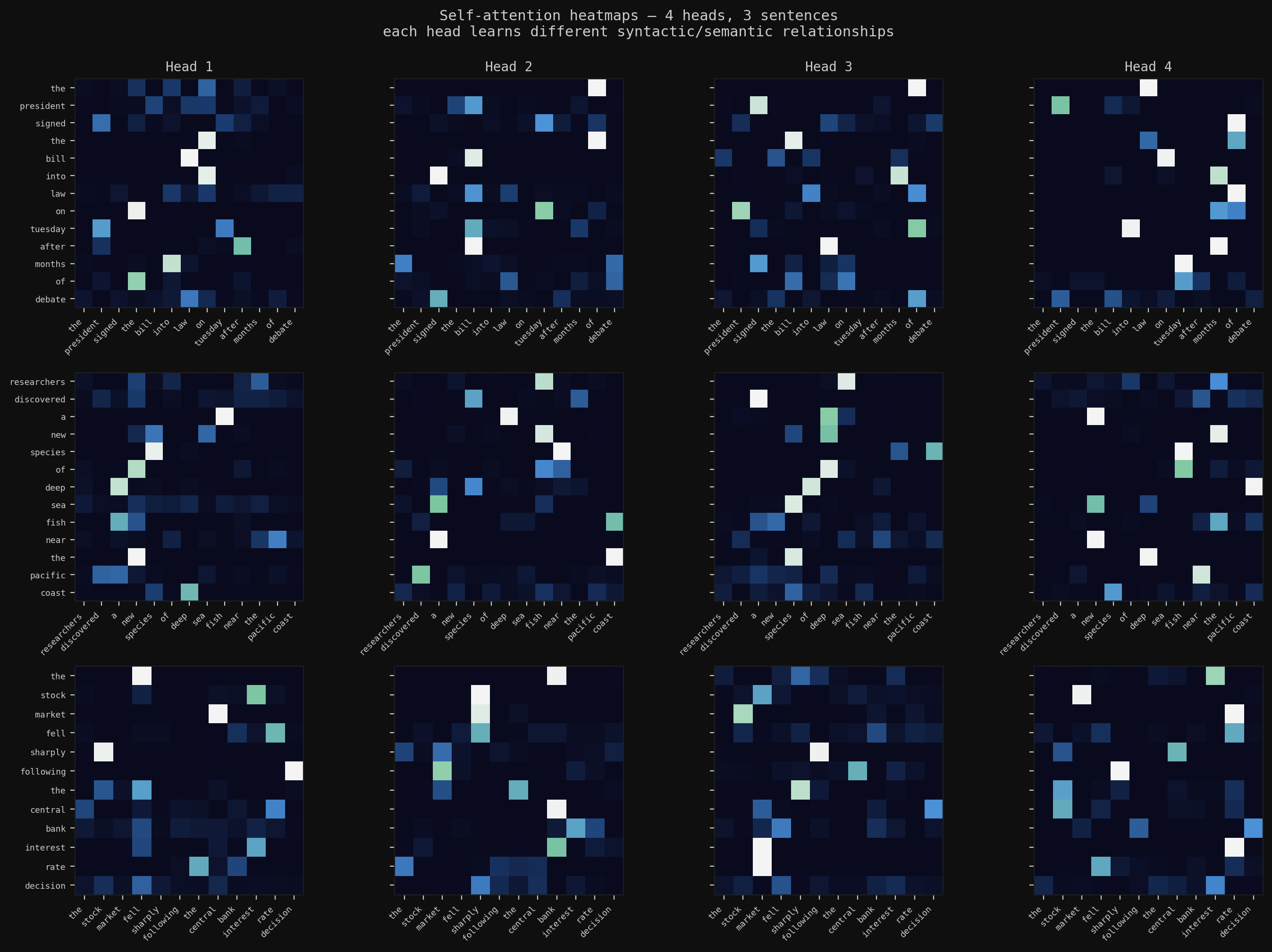
Deep Learning from Scratch
The full arc: backpropagation in raw NumPy, CNNs with BatchNorm and Dropout trained to 78% on CIFAR-10, multi-head self-attention for text summarization, and a Masked Autoencoder that reconstructs images from 25% of their patches, then transfers those features to downstream tasks.
Classical ML from Scratch
Two learning paradigms built from NumPy up: tree-based spam classification (decision tree, Random Forest, AdaBoost) and SVD/ALS matrix factorization for movie recommendations. No frameworks; matched scikit-learn on both.
Entropy Wordle Solver
Information-theoretic greedy solver that picks each guess to maximize expected entropy over the remaining word set, averaging 3.92 guesses across 300+ games.